
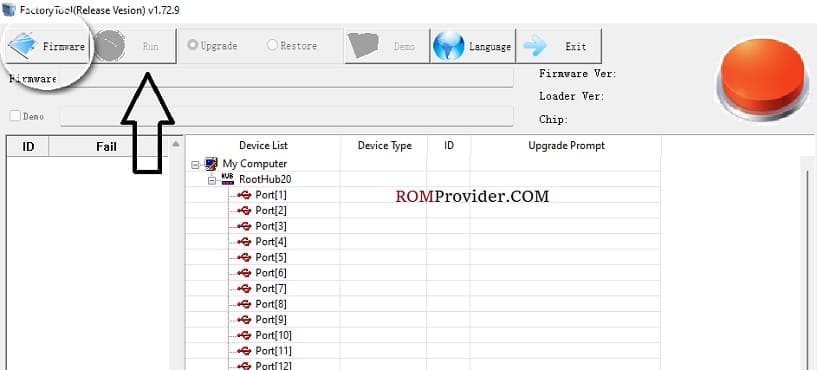
The RockChip Multiport FactoryTool is an official production-grade system utility developed by Rockchip Electronics Co., Ltd. Engineered primarily for manufacturing lines and heavy repair environments, this powerful utility allows users to flash stock firmware, execute mass batch updates, and recover corrupted operating systems across multiple devices simultaneously.
Whether you are configuring Android TV boxes, tablet PCs, smart home interfaces, or development single-board computers running on Rockchip (RK) processors, this utility establishes a rock-solid data bridge over standard USB connection ports. It automatically routes image files directly to the core partition levels to repair bootloops, clear security parameters, and install custom systems effortlessly.
📥 Direct Download & Core Prerequisite Section
Get the official installer files from our high-speed, direct repository below.
| Software Utility Module Name | Release Build | Direct Download Link |
| RockChip Multiport FactoryTool | v1.72.9 (Latest) | 📂 Download FactoryTool v1.72.9 Now |
| Rockchip DriverAssistant | Rockchip USB Drivers | 📂 Download Rockchip DriverAssistant |
📋 Technical Specifications & Server Note:
-
File Architecture: 100% Portable ZIP Package (Just extract and run).
-
Supported OS: Windows 7, 8, 10, 11 (32-bit & 64-bit).
-
Firmware Format Support: Compiled
.imgfactory profiles or raw configuration.binlayout blocks.
Core Capabilities of Multiport FactoryTool
-
Simultaneous Batch Flashing: Features multi-channel COM mapping allowing technicians to wire up and flash multiple devices at the exact same time without speed drops.
-
Intelligent Device Detection: Built-in automated monitoring scripts instantly recognize newly wired Rockchip chipsets when they enter download or loader states.
-
Streamlined Control Panel: Clean, minimalist graphical interface designed to minimize human input error, reducing complex configurations down to simple point-and-click actions.
-
Complete Hardware Unbricking: Bypasses basic OS layers to rewrite structural sectors directly, making it highly effective for repairing totally dead electronics.
How to Use RockChip Multiport FactoryTool (Step-by-Step)
Follow these exact operational steps to properly map your document streams and flash your factory firmware.
Step 1: Extract and Initialize Setup
-
Download the RockChip Multiport FactoryTool v1.72.9 archive from the download block above.
-
Extract the compressed archive contents onto an easily accessible directory closer to the root of your hard drive (Example:
C:\FactoryTool\) using WinRAR or 7-Zip. -
Make sure you install the necessary low-level USB configurations using the Rockchip DriverAssistant before running the utility.
Step 2: Open the Production Workspace
-
Open your extracted utility folder, locate
FactoryTool.exe, right-click it, and click Run as Administrator. -
The user console panel will load up into standby, presenting multiple grid rows corresponding to active USB ports.
Step 3: Load the Stock System Image
-
Click on the Firmware action button located directly at the top left menu section of the window.
-
An interactive browser directory box will pop up on your monitor screen.
-
Navigate your storage files to choose your device’s official factory firmware (Look for a specific
.imgimage or raw.binlayout document) and click Open.
Step 4: Establish Emergency Device Hookup
-
Turn off your target Rockchip tablet or TV box completely.
-
Press and hold down the physical Volume Up + Volume Down keys together. (Note: If your TV box features a hidden hardware recovery button inside the audio AV jack port instead, compress that button using a non-conductive toothpick or pin).
-
While holding the boot keys down firmly, plug the device into your PC with a high-quality USB data wire.
-
The application dashboard rows will instantly light up and change color, confirming a device connection detection line. You can now release the physical buttons.
Step 5: Execute the Flash Script and Boot
-
Click on the large RUN execution button located in the primary control pane.
-
Leave the data lines completely undisturbed while the engine formats memory blocks and copies the structural firmware sectors sequentially.
-
Completion: Wait patiently until the loading state displays a success confirmation prompt. Unplug the USB cable from the port interface and switch your freshly restored device back on!